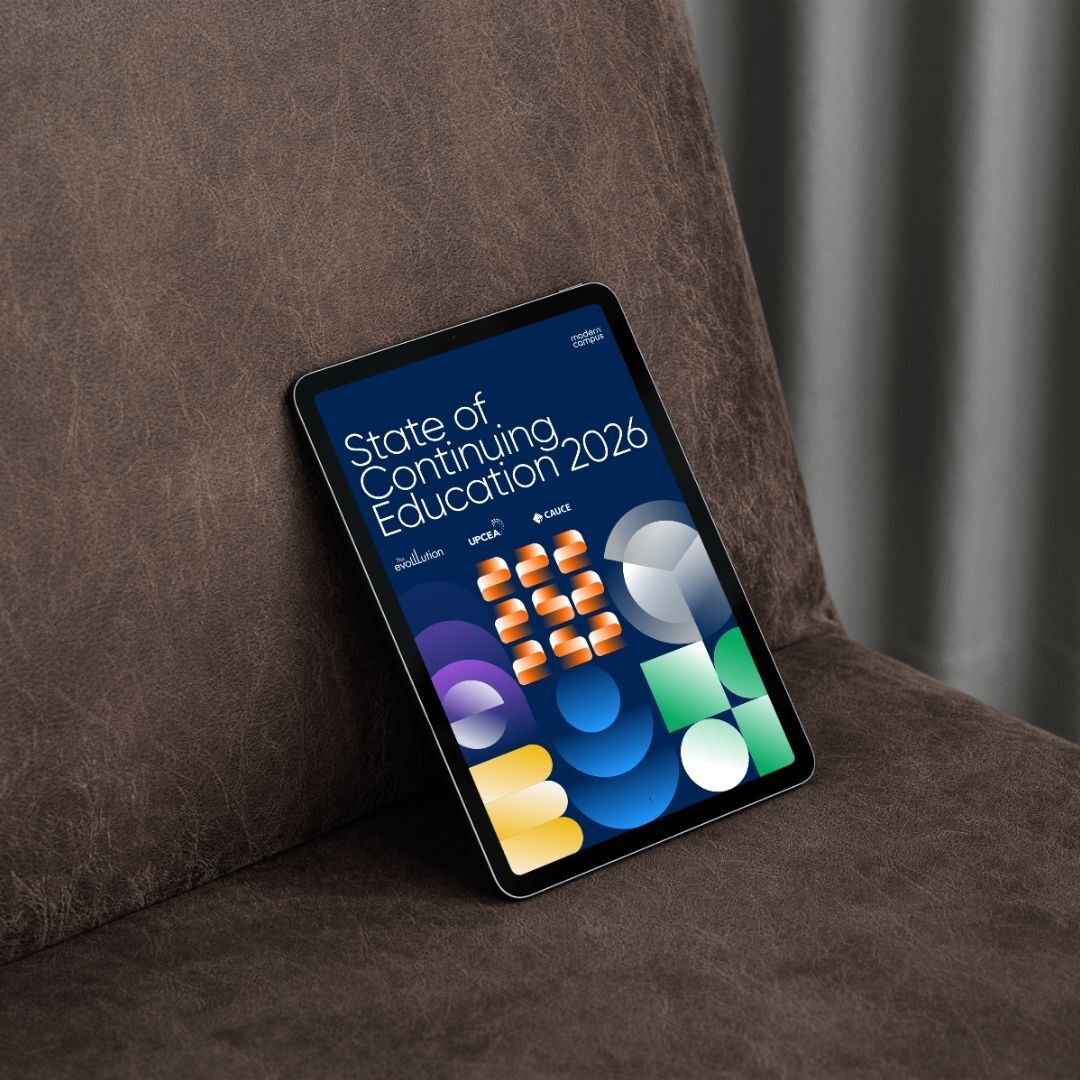
State of Continuing Education 2026
Data and insights brought to you by Modern Campus, The EvoLLLution, UPCEA, and CAUCE


Authors
Emily West
Senior Market Research Analyst
UPCEA Research & Consulting
Scott Hinty
Market Researcher
UPCEA Research & Consulting
Shauna Cox
Editor-in-Chief
The EvoLLLution, A Modern Campus Illumination
Executive Summary
Key Findings
Click each tab to get an overview
In 2024–2025, the average enrollment for online and PCE units increased slightly to 16,046, up from 15,925 the prior year, though still below pre-pandemic highs. (18,940)
Twenty-three percent said all revenue is sent back to the Provost’s office or another centralized unit, 23% said a flat percentage of online and PCE revenue is sent, and 16% said their online and PCE unit does not return any revenue to the Provost’s office or any other centralized unit.
Thirty percent lack marketing support, 22% lack instructional designers, and 21% lack business development roles, highlighting a talent shortage in growth-driving functions.
Sixty-seven percent report they are at least somewhat likely to expand workforce-aligned programs in response to Workforce Pell, yet 42% say they are not prepared to meet associated data reporting requirements.
Agreement that digital credentials effectively signal skills to employers declined from 68% in 2025 to 62% in 2026. Confidence in AI’s role in validating credentials also fell to 52%.
Sixty-four percent of respondents agree that AI enhances academic innovation, but only 27% say their unit’s technology integrates seamlessly with main campus systems.
Agreement that other units collaborate on continuing education development declined from 71% in 2025 to 62% in 2026, and perceptions of a concentrated effort from institutional leadership to manage continuing education dropped from 58% to 48%.
Program Offerings and Enrollments
👇 Mouse over charts to view interactivity elements
Institutional Readiness for Workforce Pell
Institutional Support & Capabilities
👇 Mouse over charts to view interactivity
Business Goals
Registration Systems
Data Access
Online & PCE Units
Digital Credentials
Technology Integration and Innovation
👇 Mouse over charts to view interactivity
Continuing Education Collaboration and Integration
👇 Mouse over charts to view interactivity
Demographics
👇 Mouse over charts to view interactivity elements
Survey Methodology
To better understand online and professional continuing education (PCE) unit program offerings, institutional support and capabilities, and to assess continuing education collaboration and integration, UPCEA and The EvoLLLution developed an in-depth survey.
Goal
The goal is to understand the current state of continuing education so that institutions can better engage existing and new audiences.
Logistics
UPCEA, The EvoLLLution, and CAUCE contacted their members to participate. Precautions were taken to ensure institutions were not contacted by more than one organization. The survey took place from January 13th to February 8th, 2026.
Impact on Higher Education
The 2026 findings leave little doubt that workforce alignment is no longer an emerging priority for online and PCE units. It is shaping portfolio decisions, partnership models, and performance expectations across the institution. Record-high microcredential adoption, alongside growth in stackable and industry-aligned credentials, reflects a broader institutional shift toward shorter, skills-focused learning pathways that respond more directly to labor market signals.
However, the data reinforces the stubborn and ongoing gap between strategic ambition and operational capacity. Institutions are eager to expand workforce-aligned programming, yet concerns about market demand, administrative complexity, and time-to-market now outweigh traditional academic barriers such as faculty resistance. Governance structures, approval processes, and cross-unit coordination are becoming the true constraints on responsiveness.
Workforce Pell brings this tension into sharper focus. Institutions broadly believe these programs will benefit learners and support institutional sustainability. However, readiness challenges related to data collection, reporting, and integration with state longitudinal data systems further illuminate weaknesses in infrastructure. As accountability expectations rise, online and PCE units will need to address persistent challenges related to data governance, ownership of outcomes tracking, and technology integration. The implications extend well beyond continuing education units and into institutional research, finance, and academic affairs, requiring coordinated action across the organization.
Technology integration remains a persistent friction point. Fewer than one-third of survey participants report seamless integration between continuing education systems and main campus technology, and confidence in real-time enrollment data access has declined year over year. Without shared data visibility, institutions will continue to struggle to make informed portfolio decisions, align marketing investments, and demonstrate measurable outcomes. As credentials become shorter and more outcomes-sensitive, the need for timely, integrated data will only intensify. Institutions that fail to close this gap risk slowing innovation and weakening accountability.
Audience diversification of online and PCE units is also reshaping institutional positioning. Growth in serving alumni, government, and corporate audiences strengthens continuing education’s role in regional engagement and lifelong learning ecosystems. Declining engagement with certain employer segments suggests more selective market strategies. Institutions may be prioritizing partnership depth and sustainability over breadth, which could redefine how higher education competes in workforce development markets.
Finally, internal capacity such as widening gaps in marketing and instructional design support, combined with persistent staffing concerns, signal that scale will depend on investment in people as much as programs. Leadership support remains strong, but sustained impact will require aligning financial models, staffing structures, and technology systems with the ambitions that continuing education carries.
In 2026, continuing education stands at the center of institutional adaptation. The question for online and PCE units is no longer whether to pursue workforce-aligned learning. It is whether institutions can build the operational foundation required to align infrastructure, staffing, data systems, and governance with their strategic ambitions.
Download the Print Version
If you need to print this report, download the PDF version here: